

Most business owners sign security monitoring contracts without reading past the price. That's understandable. These agreements are dense, full of legal language, and rarely written with the reader in mind. But the clauses you skip are often the ones that cost you most: automatic renewals that lock you in for another year, SLA terms that sound strong but are legally unenforceable, and data ownership provisions that leave your sensitive information in a grey area. This article breaks down the security monitoring contract terms explained in plain language, so you can negotiate from a position of knowledge rather than assumption.
Table of Contents
- Key takeaways
- Core components of security monitoring contracts
- Understanding SLA terms and how to negotiate them
- Termination, renewal, and exit strategy clauses
- Data protection and compliance in your contract
- My take on negotiating these contracts
- How Gointelligi supports service businesses like yours
- FAQ
Key takeaways
| Point | Details |
|---|---|
| SLAs are your main lever | Insist on measurable, enforceable metrics like MTTR and MTTD rather than vague performance "goals". |
| Termination fees hide in plain sight | Calculate early-termination costs before signing, not after you want to leave. |
| Data ownership must be explicit | Contracts should state clearly that you own your data and define how vendors must protect it. |
| Renewal clauses need a diary reminder | Automatic renewals often trigger 30 to 90 days before expiry, leaving you with no exit window. |
| Compliance alignment is non-negotiable | Breach notification timelines in your contract must match regulatory requirements such as GDPR's 72-hour rule. |
Core components of security monitoring contracts
Before you can negotiate, you need to know what you are looking at. Managed security services contracts commonly cover five core areas: scope of services, SLAs, pricing and payment, confidentiality, and termination. Each section carries real commercial weight.
Scope of services defines exactly what the vendor will monitor, detect, and respond to. Vague scope language is one of the most common sources of disputes. If the contract says "network monitoring" without specifying which systems, which hours, and which alert categories are covered, you have no basis for a complaint when something falls through the gaps.
Pricing and payment terms go beyond the monthly fee. Watch for:
- Setup or onboarding fees not included in the headline price
- Charges for additional users, sites, or devices beyond a base threshold
- Price escalation clauses tied to inflation indices or vendor discretion
- Invoicing frequency and late payment penalties
Pro Tip: Ask vendors to provide a sample invoice from an existing client of similar size. It reveals line items that the contract summary never mentions.
Contracts also affirm that you retain full ownership of your data and require vendors to protect sensitive information. This matters because if a vendor is acquired or goes out of business, data ownership language determines whether you can retrieve your records without legal complications.
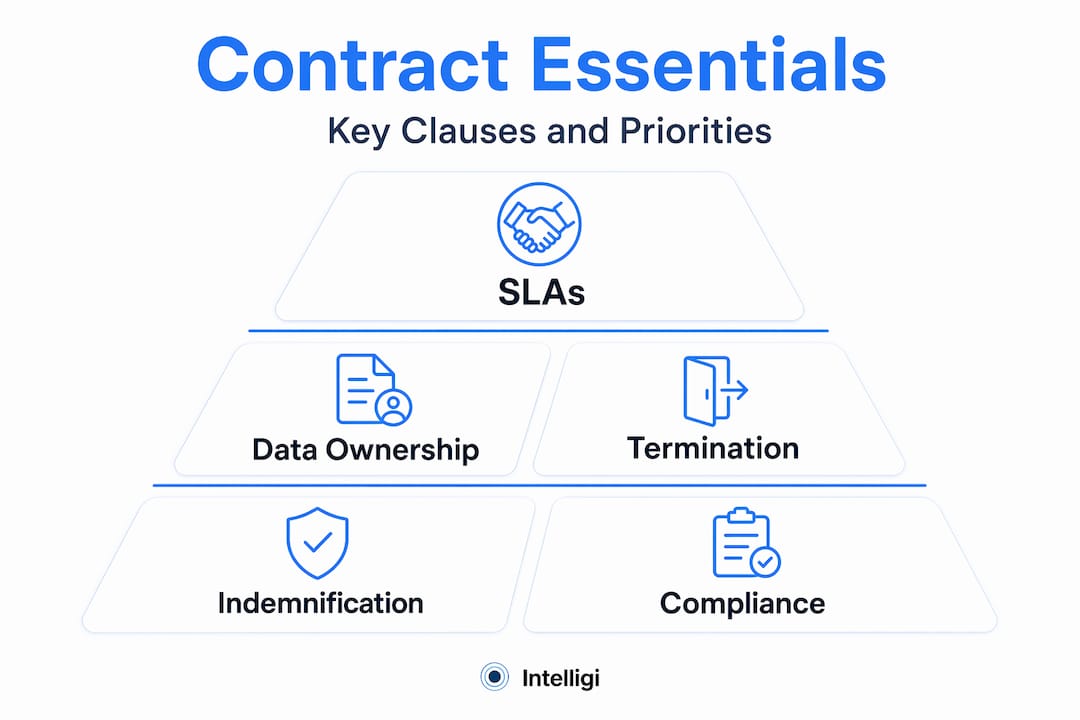
Indemnification clauses define who bears the financial risk if something goes wrong. A well-drafted clause protects you from liability arising from the vendor's errors. A poorly drafted one can leave you exposed to costs from incidents that were entirely the vendor's fault. Read this section carefully, or have a solicitor review it.
Understanding SLA terms and how to negotiate them
SLAs are where understanding security contracts moves from theoretical to practical. An SLA converts the abstract promise of "security monitoring" into a measurable commitment, and that makes it your strongest negotiation tool.
The two metrics you will encounter most often are Mean Time to Detect (MTTD) and Mean Time to Respond (MTTR). MTTD measures how quickly a threat is identified after it occurs. MTTR measures how quickly the vendor acts after detection. Both should have specific numerical targets in the contract, not aspirational language.

The 2026 AI SOC SLA guide provides concrete benchmarks worth knowing. For Priority 1 (critical) incidents, MTTR should be 30 minutes or less. For Priority 2 incidents, 2 hours is a reasonable ceiling. Anything expressed as a "best effort" commitment rather than a contractual obligation is not enforceable.
| Incident priority | MTTR benchmark | Reporting cadence | Remedy for breach |
|---|---|---|---|
| P1 Critical | ≤ 30 minutes | Immediate notification | Service credit or termination right |
| P2 High | ≤ 2 hours | Same-day report | Tiered service credit |
| P3 Medium | ≤ 8 hours | Weekly summary | Credit on monthly invoice |
| P4 Low | ≤ 24 hours | Monthly report | Logged, no financial remedy |
Two other SLA elements that most business owners overlook are measurement methodology and reporting cadence. Contracts should specify metric definitions, reporting frequency, and penalty structures to avoid vague commitments. If the contract does not state how MTTR is calculated (median per month? per incident? per calendar quarter?), the vendor can interpret the data in their favour when a dispute arises.
Financial remedies matter too. Service credits are the most common remedy for SLA breaches, but they are only useful if the credit amount is meaningful relative to the contract value. A 5% monthly credit for missing a critical response target is unlikely to reflect the actual business impact of a security incident. Push for tiered credits that escalate with repeated breaches, and insist on a termination right after a defined number of failures within a rolling period.
Pro Tip: Some managed services disclaim SLA coverage and business continuity commitments unless they are expressly identified in writing. If your vendor's standard terms contain this kind of disclaimer, treat it as a red flag and negotiate explicit coverage into the contract schedule.
Termination, renewal, and exit strategy clauses
This is the section where most business owners get caught out. Security monitoring service agreements often run for 24 to 36 months, with automatic renewal clauses that trigger if you do not give notice within a specific window before expiry.
Real-world examples show 36-month monitoring contracts with 30 days' cancellation notice requirements and termination fees calculated as the remaining months multiplied by the monthly rate. On a £500 per month contract with 18 months remaining, that is a £9,000 exit cost. Knowing that figure before you sign changes how you negotiate the initial term.
Here is a practical process for reviewing termination and renewal terms before you commit:
- Identify the initial term length. Note the exact start and end date, and calculate the total contract value.
- Find the renewal mechanism. Determine whether renewal is automatic or requires affirmative action, and note the notice window required to prevent it.
- Calculate the early-termination fee. Use the formula in the contract. If no formula is stated, ask for one in writing before signing.
- Request exit provisions in writing. Exit plans should include securing admin access, documentation packages, backup validation, and cutover coordination. These should be contractual obligations, not verbal assurances.
- Set a calendar reminder. Mark the notice deadline at least two weeks before it falls due. Automatic renewal is almost always triggered by a missed deadline, not a deliberate choice.
Early termination fees are often charged as a set percentage of the remaining contract value, and renewal timing is critical to monitor. Many businesses discover this only when they try to switch providers and receive an unexpected invoice.
One more point on exit procedures: deprovisioning and access removal should be completed and documented within 24 to 72 hours of contract termination. Auditors require timestamped evidence of credential revocation, so if your contract does not specify a deprovisioning timeline, add one during negotiation.
Data protection and compliance in your contract
Data protection clauses in security monitoring agreements are not just legal formalities. They are the foundation of your compliance posture, and gaps in this section can expose you to regulatory liability that has nothing to do with the vendor's performance.
The key areas to check are:
- Data ownership. The contract must state explicitly that you own all data generated or processed under the agreement, including logs, alerts, and reports. Ambiguous ownership language can complicate data retrieval if the relationship ends.
- Breach notification timelines. Incident-response contract terms often include notification periods that are shorter than regulatory minimums. Your contract should require the vendor to notify you within a timeframe that gives you enough room to meet the GDPR 72-hour reporting obligation to the relevant supervisory authority.
- Data retention and deletion. Specify how long the vendor retains your data after contract termination and what the deletion process looks like. Some vendors retain data indefinitely unless instructed otherwise.
- Sub-processor disclosure. If the vendor uses third-party sub-processors to deliver the service, the contract should require them to disclose who those parties are and confirm that the same data protection standards apply.
- Audit rights. You should have the contractual right to request evidence of the vendor's security controls, particularly if you are subject to ISO 27001, Cyber Essentials, or sector-specific regulations.
Pre-defining communication roles and timing before incidents occur helps meet strict regulatory notification deadlines. This is not something you want to negotiate under pressure after a breach has already happened. Build it into the contract from the start.
My take on negotiating these contracts
I've reviewed enough security monitoring agreements to know that most business owners approach them the wrong way. They focus on price and ignore the clauses that actually determine whether the relationship works.
In my experience, the SLA section is where you have the most leverage before signing, and the least leverage after. Vendors expect negotiation on price. They are far less prepared for a client who comes in with specific MTTR benchmarks, measurement methodology requirements, and tiered remedy structures. That level of preparation signals that you know what you are buying, and it changes the dynamic of the entire conversation.
The termination section is where I see the most regret. I've spoken with business owners who discovered their exit fee only when they tried to leave a provider they were unhappy with. Hidden lock-in through renewal terms and costly termination fee formulas are common. The fix is simple: request the full contract before signing, not a summary, and run the termination fee calculation yourself.
My strongest advice is to treat the contract review as a pre-flight checklist, not a formality. Read the data protection clauses before you need them. Understand the exit process before you want to use it. The business owners who do this once rarely get caught out twice.
— Stjepan
How Gointelligi supports service businesses like yours
Managing a security monitoring contract does not end at signing. Proposals need following up, renewal dates need tracking, and urgent vendor communications need a response before they become problems. That is exactly where Gointelligi comes in.
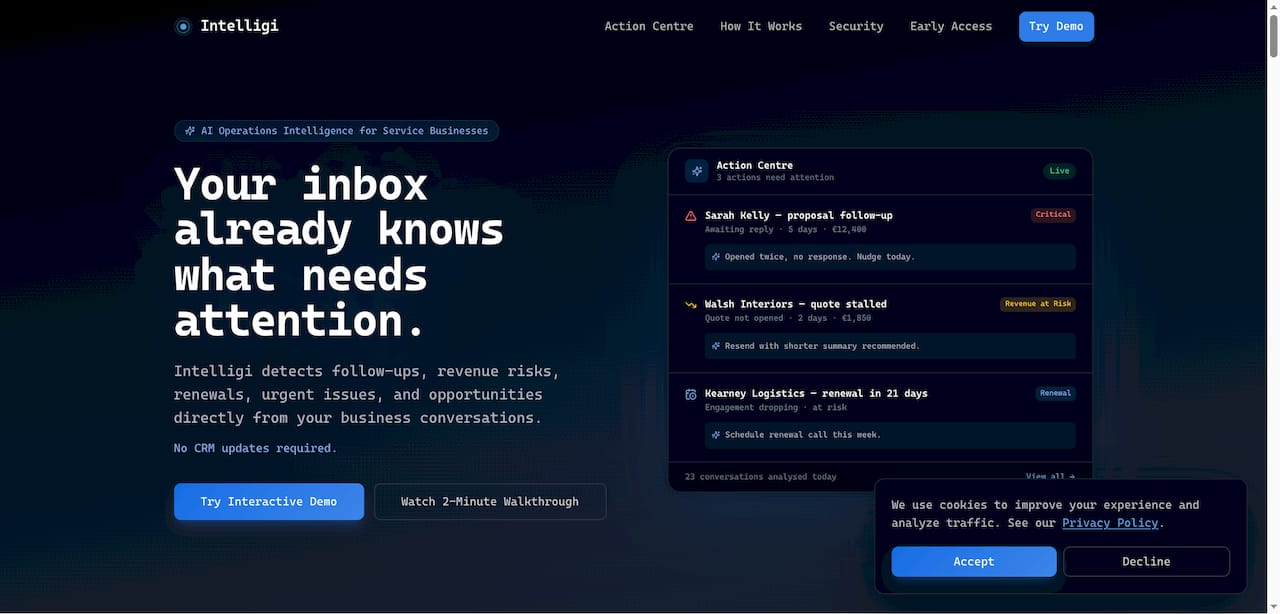
Gointelligi's AI inbox intelligence analyses your email conversations in real time, surfacing critical follow-ups, renewal risks, and missed opportunities without requiring any manual CRM updates. For service businesses managing multiple vendor relationships, monitoring contracts, and compliance deadlines, that means nothing falls through the gaps. If a vendor sends a renewal notice buried in a long email thread, Gointelligi flags it before the window closes. It is the operational layer that keeps your contract management as sharp as the contracts themselves.
FAQ
What are the most important clauses in a security monitoring contract?
The most critical clauses cover SLAs, termination fees, data ownership, and breach notification timelines. These four areas carry the highest commercial and compliance risk if left vague or unreviewed.
How do I read and understand SLA terms in a security agreement?
Look for specific metrics such as MTTR and MTTD with numerical targets, a defined measurement methodology, and clear remedies for breaches. Vague language like "best effort" is not enforceable and should be replaced with contractual commitments.
What happens if I want to exit a security monitoring contract early?
Most contracts charge an early-termination fee calculated as a percentage of the remaining contract value or the remaining months multiplied by the monthly rate. Calculate this figure before signing so you understand the full cost of exit.
How should data protection be addressed in a security monitoring agreement?
The contract should explicitly state that you own your data, require the vendor to notify you of breaches within a timeframe that allows GDPR compliance, and specify data retention and deletion obligations after the contract ends.
What is an automatic renewal clause and how do I avoid being caught by one?
An automatic renewal clause extends the contract for a further term unless you give notice within a specified window before expiry. Set a calendar reminder at least two weeks before the notice deadline to avoid being locked into a renewal you did not intend.