

Losing a client rarely happens overnight. The signals are almost always there weeks or months in advance: slower email replies, disengaged stakeholders, feedback that feels more perfunctory than genuine. The problem is that most agencies only notice these signals after the client has already made up their mind. Learning to identify at-risk agency client accounts before that tipping point is not just a retention tactic. It is the difference between a proactive agency and one that is perpetually surprised by churn. This guide walks you through the frameworks, processes, and tools to spot risk early and act decisively.
Table of Contents
- Key takeaways
- Prerequisites to identify at-risk agency client accounts
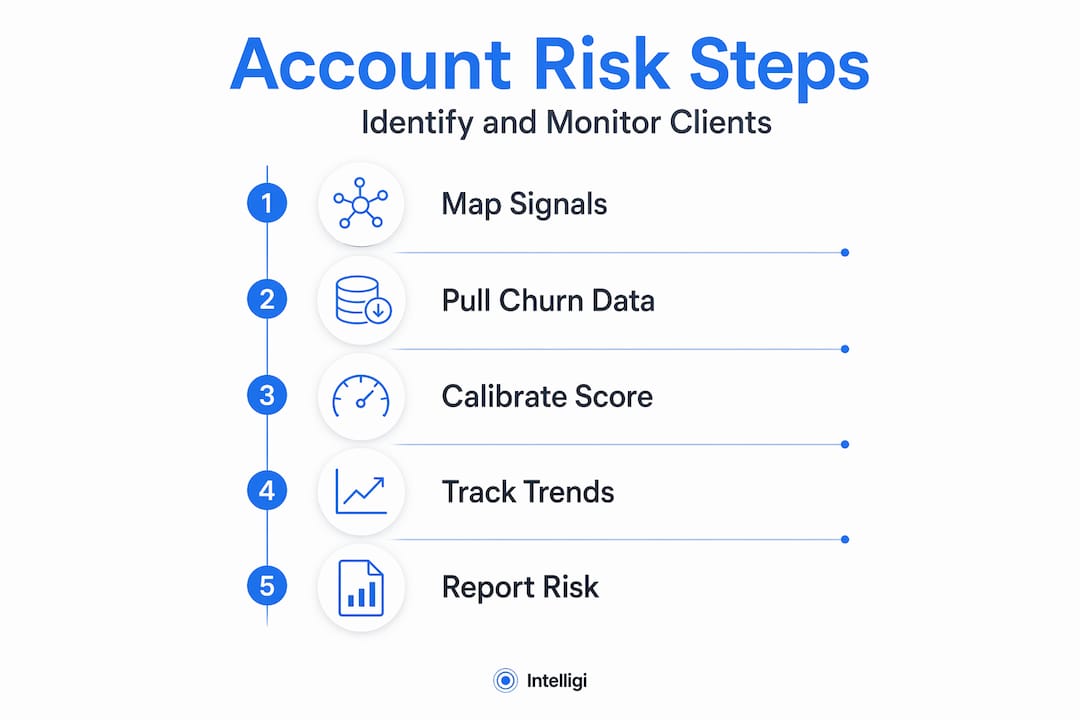
- Detecting and monitoring at-risk accounts step by step
- Common pitfalls when assessing client account stability
- Integrating risk insights into retention and proposal workflows
- My take on turning risk identification into retention wins
- How Gointelligi helps you spot at-risk clients earlier
- FAQ
Key takeaways
| Point | Details |
|---|---|
| Build a calibrated health score | Use 5 to 8 validated signals, recalibrated quarterly, to reliably predict churn 30 to 90 days out. |
| Define risk tiers with SLAs | Assign response deadlines to each tier so at-risk accounts trigger outreach within 48 hours and critical ones within 24. |
| Monitor communication decay | A 50% increase in email response time is a measurable early warning sign that warrants immediate review. |
| Avoid dashboard over-reliance | Automated scores miss silent churn; combine them with human judgement and conversation analysis. |
| Tie risk to reporting narratives | Linking risk status to the next 30 days of deliverables reduces churn and strengthens renewal proposals. |
Prerequisites to identify at-risk agency client accounts
Before you can reliably detect high-risk client accounts, you need the right inputs. Too many agencies attempt risk monitoring with incomplete data and then wonder why their early warning system keeps failing them.
The four data sources that matter most are:
- Communication signals: Email response times, meeting attendance, the ratio of client-initiated to agency-initiated contact, and the tone of written exchanges.
- Financial signals: Payment delays, scope reduction requests, budget queries outside normal review cycles, and declined upsells.
- Usage and engagement signals: For agencies with client portals or reporting dashboards, login frequency and report download rates reveal engagement levels.
- Sentiment signals: NPS responses, feedback on deliverables, and qualitative comments from account reviews.
With those inputs established, you need a health scoring model calibrated to your specific client base. Health scores built from 5 to 8 highest-correlation signals, validated through regression analysis and recalibrated quarterly, predict churn reliably 30 to 90 days in advance. Generic industry templates rarely hold up because your client mix is unique. A digital marketing agency retaining e-commerce brands will weight signals differently from a PR agency serving professional services firms.
Pro Tip: Before building your health score, pull data on your last 10 churned clients and identify the three signals that appeared most consistently in the 60 days before they left. Those become your anchor metrics.
Your technology stack also matters here. A CRM alone is insufficient if account managers are not updating it consistently. The more your monitoring framework depends on manual data entry, the more gaps you will have. AI-assisted tools that analyse real-time interactions from your inbox and meeting records fill those gaps without requiring anyone to remember to log a note.
Finally, establish a reporting cadence with structured checkpoints. Renewal risk frameworks that include fixed reviews at six months and three months before renewal, combining automated signals with account manager assessments and leadership sign-off, consistently catch risks that ad hoc monitoring misses.
| Data source | What to measure | Frequency |
|---|---|---|
| Email communications | Response time, initiation ratio, tone | Weekly |
| Financial records | Payment timing, scope changes | Monthly |
| Engagement metrics | Portal logins, report downloads | Weekly |
| Sentiment feedback | NPS, review scores, qualitative notes | Per touchpoint |
Detecting and monitoring at-risk accounts step by step
Once your foundations are in place, the process of monitoring agency client risks becomes repeatable. Here is how to structure it.
-
Aggregate your signals weekly. Pull communication data, financial records, and engagement metrics into a single view. Do not rely on account managers to surface concerns manually. Systematise the collection so nothing depends on someone remembering to flag it.
-
Calculate and validate health scores. Apply your weighted scoring model to each account. Calibrating thresholds based on your historical churn data yields better predictive accuracy than any off-the-shelf benchmark. A score that looks healthy for one agency type may signal moderate risk for yours.
-
Assign accounts to risk tiers. A four-tier model works well in practice:
| Tier | Score range | Required response |
|---|---|---|
| Thriving | 75 to 100 | Standard cadence |
| Healthy | 60 to 74 | Monitor closely |
| At-risk | 40 to 59 | Outreach within 48 hours |
| Critical | Below 40 | Escalation within 24 hours |
-
Set velocity triggers. A score drop of more than 20 points in seven days should override normal cadences and force immediate escalation regardless of the absolute score. Gradual decline is dangerous, but rapid decline is urgent.
-
Add qualitative flags. Numbers tell you something is wrong. Conversations tell you why. Review recent email threads and meeting notes for language that signals disengagement: shorter replies, questions about contract terms, references to competitor solutions, or a shift from collaborative to transactional tone.
-
Use AI to surface what humans miss. Analysing customer conversations with AI delivers earlier and clearer insights than dashboard monitoring alone. Tools that assign risk levels based on conversational and engagement signals, with recommended playbooks attached, turn a passive score into a prioritised action list. For example, Gainsight's risk scoring assigns a 1 to 5 level based on these signals, with level 4 triggering escalation and level 5 marking an account as critical.
Pro Tip: Do not wait for a client to complain. A 50% increase in email response time is a measurable churn predictor 30 to 90 days before departure. Build that metric into your weekly review.
Common pitfalls when assessing client account stability
Even agencies with solid frameworks make predictable mistakes. Recognising them is the first step to fixing them.

The most common error is treating a health score as a verdict rather than a prompt. Account managers see a green score and stop looking. But silent churn happens precisely when dashboards show healthy metrics while unstructured communications reveal client hesitation. A client who stops asking questions in meetings is not necessarily satisfied. They may have already started evaluating alternatives.
Other pitfalls to watch for:
- Signal overload. Including too many metrics in a health score dilutes its predictive power. Overloading health scores with excessive signals reduces accuracy. Stick to 5 to 8 validated, high-correlation indicators.
- No ownership. A risk flag without a named owner and a deadline is just a data point. Every at-risk account needs a person responsible for the next action and a date by which it must happen.
- Waiting for overt signals. Payment failures and formal complaints are late-stage indicators. By the time a client raises a formal grievance, the emotional decision to leave has usually already been made.
- Ignoring micro-moments. A client who declines a quarterly review invitation, stops copying their director on emails, or takes three days to approve a deliverable they used to approve in hours. These are micro-moments that rarely appear in any dashboard but consistently precede churn.
"Reporting that informs instead of advises is one of the key risk drivers for agency client churn." Growth Rocket
That quote captures something agencies consistently underestimate. Clients who receive data without context feel managed rather than partnered. When your reporting tells them what happened but not what it means for their business next month, you are creating a gap that a competitor will happily fill.
Integrating risk insights into retention and proposal workflows
Identifying risk is only half the job. The other half is translating that insight into action before the client reaches a decision point.
-
Build execution-ready playbooks. Each risk reason should have a corresponding playbook: a defined sequence of outreach steps, talking points, and escalation triggers, each with a named owner and deadline. Vague guidance like "re-engage the client" does not get executed consistently.
-
Reframe your reporting. Linking risk diagnosis to the next 30 days of deliverables in client reports reduces churn by increasing transparency and gives you proposal-ready narratives for renewal conversations. Instead of showing last month's results, show what those results mean for next month's priorities.
-
Use risk status in renewal forecasting. Structured renewal checkpoints at six and three months before renewal, combining automated signals with account manager assessments, give leadership enough time to intervene meaningfully rather than scrambling in the final weeks.
-
Escalate high-value at-risk accounts with urgency. For clients whose engagement has dropped sharply, executive sponsor involvement within five business days is recommended. Pair that with a competitive displacement assessment to understand whether a rival agency is already in the conversation.
-
Track intervention outcomes. Every playbook execution should feed back into your detection model. If a particular intervention consistently fails to retain clients at a specific risk tier, that tells you something important about either the intervention or how you are classifying risk.
| Risk tier | Intervention type | Owner | Timeline |
|---|---|---|---|
| At-risk | Proactive check-in call, report reframe | Account manager | Within 48 hours |
| Critical | Executive escalation, competitive review | Account director | Within 24 hours |
| Post-intervention | Outcome logged, score recalibrated | Account manager | Within 7 days |
Pro Tip: Cross-functional alignment matters here. Sales, account management, and operations need to share risk data. A sales team pitching an upsell to a client that operations has flagged as critical is a trust-destroying experience for everyone involved.
My take on turning risk identification into retention wins
I have watched agencies invest in dashboards, health scores, and reporting tools, and still lose clients they should have kept. The technology is rarely the problem. The problem is that risk identification gets treated as a reporting exercise rather than an operational one.
In my experience, the agencies that retain the most clients are not necessarily the ones with the most sophisticated scoring models. They are the ones where account managers genuinely believe the data and act on it without waiting for permission. That requires a culture shift as much as a process change.
What changed our retention rates was not adding more signals to the health score. It was reducing them and being ruthless about which three or four metrics actually predicted churn in our specific client base. Once the signal-to-noise ratio improved, the scores became credible, and account managers started trusting them enough to act early.
The other thing I would stress is the value of narrative over numbers in client-facing reporting. Clients do not churn because results were mediocre. They churn because they stopped believing the agency understood their business. A report that connects last month's performance to next month's decisions does more for retention than any score ever will. Renewal risk identification must combine automated scoring with human judgement. That combination, done consistently, is where retention wins come from.
— Stjepan
How Gointelligi helps you spot at-risk clients earlier
Most agencies lose clients because the warning signs lived in their inbox the whole time and nobody had a system to surface them.
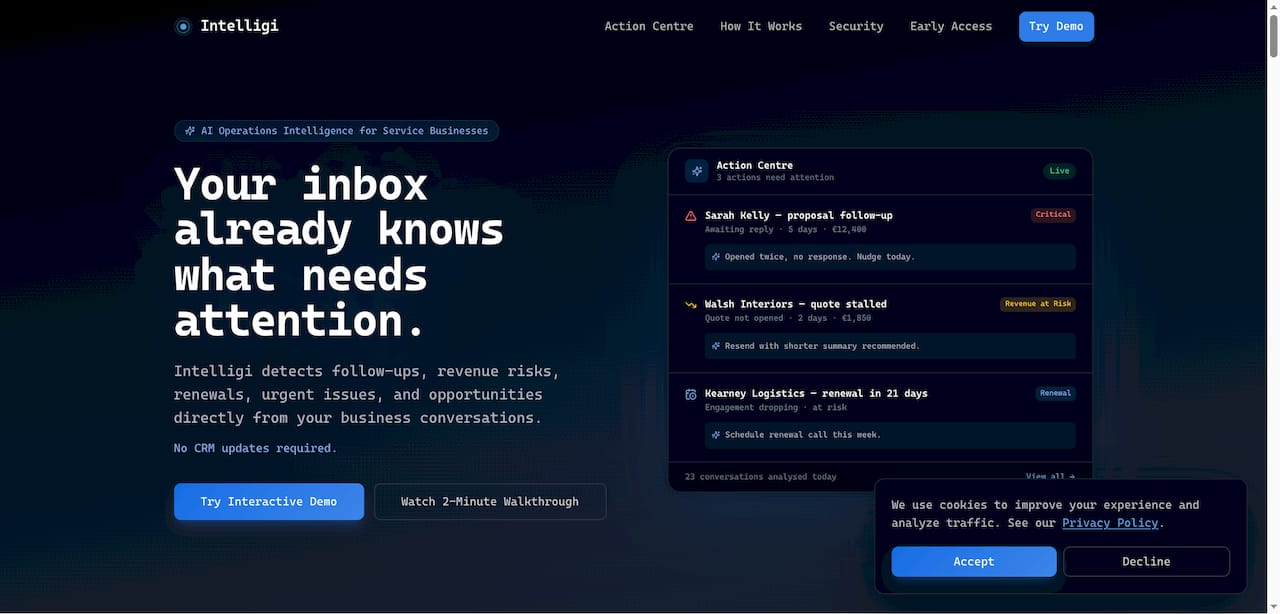
Gointelligi's AI inbox intelligence reads your email conversations, meeting records, and digital interactions to flag revenue risks, stalled proposals, and disengaged clients before they become churn statistics. It does not require manual CRM updates or additional data entry. The platform surfaces what your existing communications already contain, giving account managers and directors a prioritised view of which clients need attention today and why. For agencies managing complex client portfolios, that kind of signal clarity is what separates proactive retention from reactive damage control. Explore Gointelligi to see how it fits into your risk monitoring workflow.
FAQ
What signals indicate an agency client is at risk?
Key signals include slower email response times, reduced meeting attendance, scope reduction requests, declining engagement with reports, and a shift from collaborative to transactional communication. A 50% increase in email response time alone can predict churn 30 to 90 days before departure.
How many signals should an agency health score include?
Health scores should use 5 to 8 high-correlation signals validated against your historical churn data and recalibrated quarterly. Fewer, well-chosen signals consistently outperform broad models with excessive metrics.
When should an at-risk client account be escalated?
Accounts scoring in the critical tier should receive escalation within 24 hours. A score drop of more than 20 points in seven days should trigger immediate escalation regardless of the absolute score, as velocity of decline is as important as current standing.
How does risk identification improve renewal proposals?
Linking risk status and intervention history to renewal conversations gives account managers a narrative grounded in evidence. Clients who see that their agency identified a challenge and addressed it proactively are far more likely to renew than those who receive a generic proposal.
What is silent churn and why does it matter for agencies?
Silent churn occurs when health score metrics appear stable but client communications reveal disengagement or hesitation. It matters because it is invisible to dashboard-only monitoring and requires conversation analysis to detect before the client formally decides to leave.